
गृहपृष्ठ 8% economic growth rate for Nepal: is it possible?
8% economic growth rate for Nepal: is it possible?
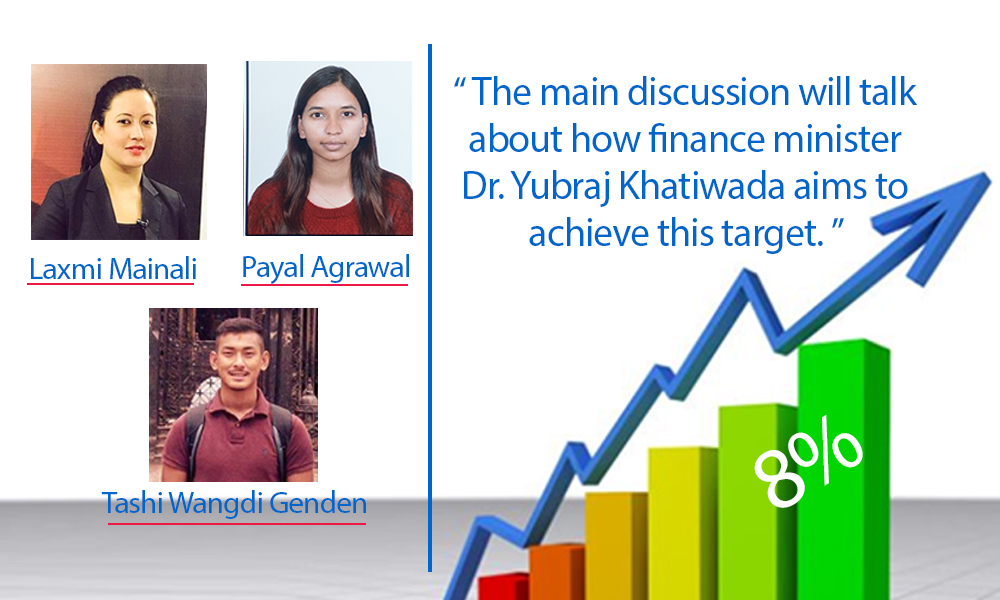
Announcing the budget for the new fiscal year 2075/076, Finance Minister Dr. Yubraj Khatiwada set the ambitious target of eight percent of economic growth rate. While the target was highly appreciated by everyone; Lawmakers, economists, scholars and the general public did not believe that this target can be achieved. Though, Khatiwada laid down his plans and goals giving plausible explanation as to how he aims to achieve the target set. The public have criticized and argued that the goals set to achieve the target of eight percent is unrealistic and ‘overly ambitious’. The main discussion will talk about how finance minister Dr. Yubraj Khatiwada aims to achieve this target, the industries that will be focused and if the target can be achieved or not.
In order to achieve the target, three main sectors will be given top priority; agriculture, industrial and service sectors. Development in these three sector will make it possible to achieve the desired economic growth rate. For this, both the public, private sector and the Government must work together. We, as citizens, need to stop criticizing and start believing. The government needs to provide full support from their side by reducing bureaucratic practices in decision making and create economic policies that favor development projects.
Agriculture is one of the major sector of Nepalese economy which Khatiwada relies on to spur growth. According to Department of Agriculture, agriculture provides employment opportunities to 66 percent of the total population and contributes about 36 percent in the GDP. The budget has set an ambitious target of doubling Agriculture output growth rate from a target of current 2.8% to 4.5 % in a span of five years. “It means a 50 percent annual growth requirement that no country in the world has achieved,” said Mahat. Inspite of criticisms khatiwada claims that the aim of doubling agricultural production within five years is possible. Promotion of agro industries, encouraging the use of technology in agriculture and especially running the Prime Minister’s Agriculture Modernization Project in full swing can help achieve the target.
Shortage of electricity has been one of the key binding constraints for higher economic growth. Nepal’s peak electricity demand stands at around 1,380 MW. However, Nepal’s currently installed hydro-power generation capacity is only near 1000 MW. To solve this situation, Nepal is bound to purchase electricity from India during the dry months. However, the shadow of the 2015 economic blockade looms in the background to remind why such a setup is unsustainable. For this, the best solution is sustained self-production. The completion of the Upper Tamakoshi would have a positive impact on the industrial sector allowing most of the factories to operate under full or near to full capacity.
Another important sector is the service sector, more specifically tourism sector, hospitality sector and primary objective is attracting two million tourists annually by 2020. To increase the inflow of foreign tourists, Khatiwada plans to speed up the processes of constructing all planned domestic and international airports, identify new tourist’s destinations apart from the usual Chitwan, Pokhara, Kathmandu trio, initiate special tourism promotion packages targeting Chinese and Indian tourists and celebrate 2020 as ‘Visit Nepal Year’.
To support the development in agriculture, industrial and service sectors, it is essential to have a strong infrastructure. Special focus has been given to transportation sector. Khatiwada has mentioned ambitious infrastructure projects like the Chure Highway, Nijgad Airport, The Tarai Fast-Track, East-West Electric Railway and Kathmandu to Kerung and Raxaul railways, which has earmarked Rs 109 billion for transport alone. Roads and Railways would greatly reduce traveling time, distance & increase affordability make traveling via ground a cheaper option than air. Completion of these projects would greatly improve the transportation network within the country and provide massive job-creation in the process. However, failure in simple tasks such as maintenance of recently constructed roads in Kathmandu valley, has casted serious doubts of achievement of much bigger projects.
Chandan Sapkota gave a diplomatic response to Khatiwada saying, “Even if the agricultural sector grows by 4.5 percent and services by 8.5 percent, the industrial output should grow by 13.5 percent to achieve 8 percent GDP growth.” In other words, the plans and goals are just not attainable or realistic. To summarize all the criticisms, Economist SwarnimWagle beautifully wrote on his Facebook page that the budget does not hold bases for meeting the ambitious growth target of 8 percent, doubling tourist numbers in two years, agriculture output in five years, creating 500,000 new jobs and attaining 100 percent literacy rate within two years. His message ends in a positive note, “However, proposing a string of reforms for effective implementation of mega projects is good.”
Though I believe the target of eight percent cannot possibly be reached within the given time frame. However, it has brought into the limelight several projects which if can be completed can bring big changes; it would change the face of our country. If these projects are completed, an economic growth rate of ten percent within 2025 would easily be possible. The desired result of eight percent may not be reached, nonetheless it is sure to lay a strong foundation for Nepal to pave a path for a greater and stronger economy for the future.
(Genden, Agrawal & Mainali are the students of MBA at Ace institute of management)
प्रकाशित समय १६:१५ बजे


